
Play Tower Rush Now!
Home → Mobile
Tower Rush Mobile
Tower Rush on mobile
The Galaxsys release Tower Rush launched in 2024 as a crash game without reels, ensuring instant loading on smartphones. This architecture removes the latency of spinning animations found in traditional slots, allowing players to start rounds immediately upon tapping the screen. The absence of heavy graphical assets means the game consumes less data and battery power during extended sessions on iOS or Android devices.
This instant-play format contrasts with Chicken Road by InOut Games, which also lacks physical reels but targets massive payouts up to x3,608,855. While Tower Rush caps its maximum multiplier at x100, it offers a theoretical return of 97.00% over long-term play. Players seeking higher volatility might prefer the InOut title, but those preferring consistent small wins may find the lower cap more suitable for their bankroll management strategy.
The house edge stands at exactly 3.00%, calculated from the 97.00% RTP provided by the developer. This margin is identical to that of Aviator by Spribe, which also boasts a 97.00% return rate for its users. By comparison, Rabbit Road by InOut Games carries a higher edge of 4.50% due to its 95.50% RTP configuration. These figures define the mathematical expectation for every wager placed on the mobile interface regardless of device type.
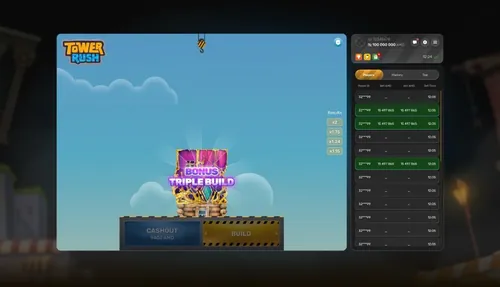
Playing in the mobile browser
The HTML5 implementation of Tower Rush allows direct access via standard browsers without requiring any application downloads from app stores. This web-based approach ensures compatibility across various operating systems and browser versions, providing a uniform experience for all users. The game relies on JavaScript execution to handle the random number generation process securely within the client environment.
Security is maintained through provably fair hash verification, which allows players to validate each round's outcome independently after it concludes. This transparency feature builds trust by letting users confirm that the tower collapse was not manipulated by the operator. Such cryptographic proof is essential for crash games, distinguishing them from opaque proprietary software used by some competitors in the market.
The theoretical return of 97.00% applies to this browser version just as it does to desktop clients, ensuring consistent odds across platforms. Operators may adjust configurations between 96.2% and 97.6%, but the core mechanic remains unchanged for the player. This variability requires attention to specific casino terms, as the actual return can fluctuate based on the site's bonus floor settings and regulatory jurisdiction requirements.
Screen layout on phones
The vertical display prioritizes the rising multiplier graph, occupying the central portion of the screen to maximize visibility of the cash-out point. Controls are positioned at the bottom, ensuring easy thumb access without obscuring the critical gameplay area where the tower ascends. This minimalist design reduces visual clutter compared to complex slot interfaces, focusing entirely on the single action of timing the exit correctly.
The interface adapts to different aspect ratios, maintaining the integrity of the multiplier curve regardless of whether the phone is tall or wide. Text elements remain legible without zooming, presenting key information like current bet size and potential winnings clearly above the control buttons. This responsive behavior prevents accidental taps and ensures that players can monitor their progress accurately during fast-paced rounds.
Visual feedback highlights successful floor completions with distinct animations, reinforcing the sense of progression toward the maximum x100 multiplier. Failed rounds trigger a collapse animation that resets the board instantly, minimizing downtime between attempts. This immediate reset capability supports rapid-fire betting strategies, allowing players to execute multiple rounds quickly without waiting for lengthy loading screens or transitions.
Touch controls and buttons
A single large button initiates each round, serving dual purposes for placing bets and triggering the auto cashout function when pre-set limits are reached. This simplified input method reduces cognitive load, enabling players to focus solely on watching the multiplier rise rather than managing complex menus. The tactile response confirms each tap, providing immediate sensory feedback that complements the visual ascent of the tower graph.
The auto cashout feature allows setting a specific multiplier threshold, such as x2.00 or x5.00, before the round begins. This tool protects profits by automatically securing winnings if the player cannot react quickly enough to the collapsing tower. It serves as a risk management mechanism, particularly useful during high-volatility sessions where sudden crashes can erase gains within milliseconds of reaching peak values.
Adjusting the stake amount involves simple plus and minus icons located near the main action button, facilitating quick changes between rounds. These controls do not interrupt ongoing gameplay, allowing adjustments to be made while waiting for the next round to start. This flexibility supports bankroll management strategies, enabling players to scale bets up or down in response to recent win or loss streaks observed in the history log.
Performance on older devices
The lightweight codebase of Tower Rush ensures smooth operation even on smartphones released several years ago, avoiding frame drops during critical moments. This performance stability is crucial for crash games, where lag could result in missing the optimal cash-out point before the tower collapses. The minimal asset requirement allows the game to run efficiently on processors with limited graphics capabilities without compromising the fairness of the RNG.
Data consumption remains low due to the absence of high-resolution textures and complex sound effects typical of modern video slots. Users on restricted mobile plans can play for extended periods without exhausting their monthly data allowances significantly. This efficiency makes the game accessible to a broader audience, including those in regions with limited internet infrastructure or expensive data packages.
The 97.00% RTP is mathematically independent of device performance, ensuring that slower hardware does not alter the underlying odds of winning. Whether played on a flagship phone or an entry-level model, the probability distribution remains identical for every wager placed. This consistency guarantees that technical limitations never disadvantage the player regarding the fundamental economic expectations of the game.
Tower Rush: key facts
| Parameter | Value |
|---|---|
| Game | Tower Rush |
| Studio | Galaxsys |
| Released | 2024 |
| RTP | 97.00% |
| House edge | 3.00% |
| Max win | 100x |
Data use during play
Galaxsys released Tower Rush in 2024, a crash/instant game that requires constant internet connectivity for its rising multiplier rounds. The theoretical RTP is 97.00%, implying a house edge of 3.00% over long runs, but operators may adjust this between 96.2% and 97.6%. High-frequency RNG updates and hash verification for provably fair results consume significant bandwidth during active sessions.
This data intensity contrasts with low-bandwidth titles like Spribe’s Dice (RTP 97.00%), which features adjustable volatility and minimal asset streaming. While Dice relies on simple text inputs, Tower Rush demands continuous downloads of visual feedback to track the cash-out point before collapse. Users on metered connections face higher costs when attempting to manage the max win cap of 100x through repeated attempts.
Playing on unstable connections
Unstable networks pose a direct threat to Tower Rush’s core mechanic: cashing out before the tower collapses. If latency spikes during a round, the player might miss the window to secure their winnings, losing the stake entirely. This risk does not exist in turn-based games like TaDa Gaming’s Chicken Dash (RTP 96.85%, max win 20,659x), where outcomes are calculated server-side without real-time input pressure.
The max multiplier of x100 in Tower Rush requires precise timing, making connection drops more punitive than in slower-paced variants. In contrast, Spribe’s Plane Game (high volatility) allows players to observe the curve before deciding, offering a slight buffer against lag. However, Tower Rush’s instant nature means even a 500ms delay can result in automatic loss, regardless of the player's intent.
Battery drain in long sessions
Long sessions in Tower Rush accelerate battery depletion due to continuous screen refreshes required to monitor the rising multiplier. Each floor stacked increases the cumulative odds, demanding constant attention to avoid the tower collapsing. This intensive usage pattern drains power faster than static or low-frame-rate casino games, reducing session longevity on mobile devices.
Comparatively, Spribe’s Dice game (RTP 97.00%) involves minimal animation, placing less strain on device resources per round. While Tower Rush offers special bonus floors like Frozen Floor and Temple Floor, these features do not offset the high CPU load from rendering the crashing tower. Players should expect significantly shorter battery life when chasing the maximum win of 100x compared to simpler instant games.
Portrait and landscape modes
Tower Rush by Galaxsys displays optimally in portrait mode, allowing players to focus on the vertical tower structure and cash-out button. The interface adapts to mobile screens, ensuring the rising multiplier remains visible without excessive scrolling. This layout differs from wider formats used in some slot-style comparisons, though Tower Rush contains no reels or paylines.
Landscape mode may distort the aspect ratio of the tower, potentially obscuring critical UI elements needed for timely cash-outs. While Spribe’s games often support both orientations seamlessly, Tower Rush’s design prioritizes vertical stacking mechanics. Players switching between modes might experience minor delays in loading the next round, affecting the flow of the crash/instant gameplay.
Sound and animation settings
Animations in Tower Rush visualize the tower rising and collapsing, enhancing the tension of each round’s multiplier climb. These visual effects run alongside sound cues that signal successful floors or crashes, providing immediate feedback on outcomes. Disabling animations reduces visual clutter but may remove subtle hints about the probability of the next floor succeeding.
Unlike TaDa Gaming’s Chicken Dash (RTP 96.85%, high volatility), which uses distinct character animations, Tower Rush relies on abstract geometric progression. The lack of complex character sprites keeps performance stable, but the absence of audio cues could impact user awareness during fast-paced rounds. Adjusting these settings does not alter the underlying RNG or the 97.00% theoretical RTP.
Phone versus desktop play
The Galaxsys title Tower Rush delivers a theoretical return to player percentage of 97.00% across all devices, establishing a house edge of 3.00% that remains constant regardless of screen size or connection stability during the session.
In contrast, the Pragmatic Play crash game Spaceman offers a lower RTP of 96.50%, meaning players retain slightly less capital over extended periods on mobile interfaces compared to the higher efficiency found in the Galaxsys architecture.
This 0.50% difference accumulates significantly for high-volume users, as every €100 wagered on Spaceman yields €0.50 less expected value than identical stakes placed on Tower Rush, directly impacting long-term bankroll sustainability.
Tablet experience
The PG Soft release Fortune Rabbit utilizes a non-standard 3-4-3 row grid with three reels, creating a distinct visual layout that differs substantially from the vertical tower structure of Tower Rush on tablet displays.
While Fortune Rabbit boasts a maximum win cap of 5000x, Tower Rush restricts its top prize to 100x, forcing players seeking extreme volatility to accept lower potential payouts in exchange for the unique tower-building mechanics available on tablets.
The medium volatility of Fortune Rabbit contrasts with the instant nature of Tower Rush, where each round involves a single rising multiplier rather than traditional reel spins, altering the pacing and decision frequency for tablet users.
What changes on a small screen
On smartphones, the interface must compress the three special bonus floor types, specifically Frozen Floor, Temple Floor, and Triple Build, into smaller touch targets while maintaining the clear visibility of the current cumulative odds.
The maximum multiplier of x100 remains the hard ceiling for wins on small screens, ensuring that the core mathematical constraint of the Galaxsys engine does not change despite the reduction in pixel density or button size.
Players must rely on the auto cashout feature more frequently on phones due to reaction time delays, as manually tapping the cashout button before the tower collapses becomes riskier when fingers obscure the critical multiplier display.
Interrupted rounds and reconnects
The Galaxsys engine employs provably fair hash verification for every round, allowing players to independently verify that their cashout timing was recorded accurately even if the mobile connection drops during the final seconds of a tower build.
If an interruption occurs before the collapse, the system retains the state of the cumulative odds, meaning the player can resume the session without losing the progress made toward the 100x maximum multiplier cap.
This reliability is crucial because the theoretical return of 97.00% assumes complete participation in verified rounds, so any unverified lost connections could theoretically skew the actual return below the stated house edge of 3.00%.
Mobile demo mode
The free play version of Tower Rush allows users to test the triple build mechanic without risking real funds, providing a safe environment to understand how the frozen floor alters the probability of reaching higher multipliers.
Although no real money is involved, the demo mode replicates the 97.00% RTP algorithm, ensuring that the frequency of bonus floors and tower collapses matches the statistical expectations of the paid version powered by Galaxsys.
Using the demo helps players grasp the impact of the 3.00% house edge on their virtual balance, preparing them mentally for the faster pace of real-money rounds where the 100x max win is the ultimate target.
DemoRTP & VolatilityHow to PlayAuto CashoutStrategyBonusesMobileDownload & AppMax WinSimilar GamesReviewFAQSitemap
Tower Rush 2026